
Air safety reporting is made accessible without a subscription as a public service. Subscribe to The Air Current for full access to our scoops, in-depth reporting and industry analysis.
NTSB investigators are probing the role a bird strike played in the fan-blade-out accident experienced by a Ryanair Boeing 737-800 last month as it climbed out of Thessaloniki International Airport in Greece.
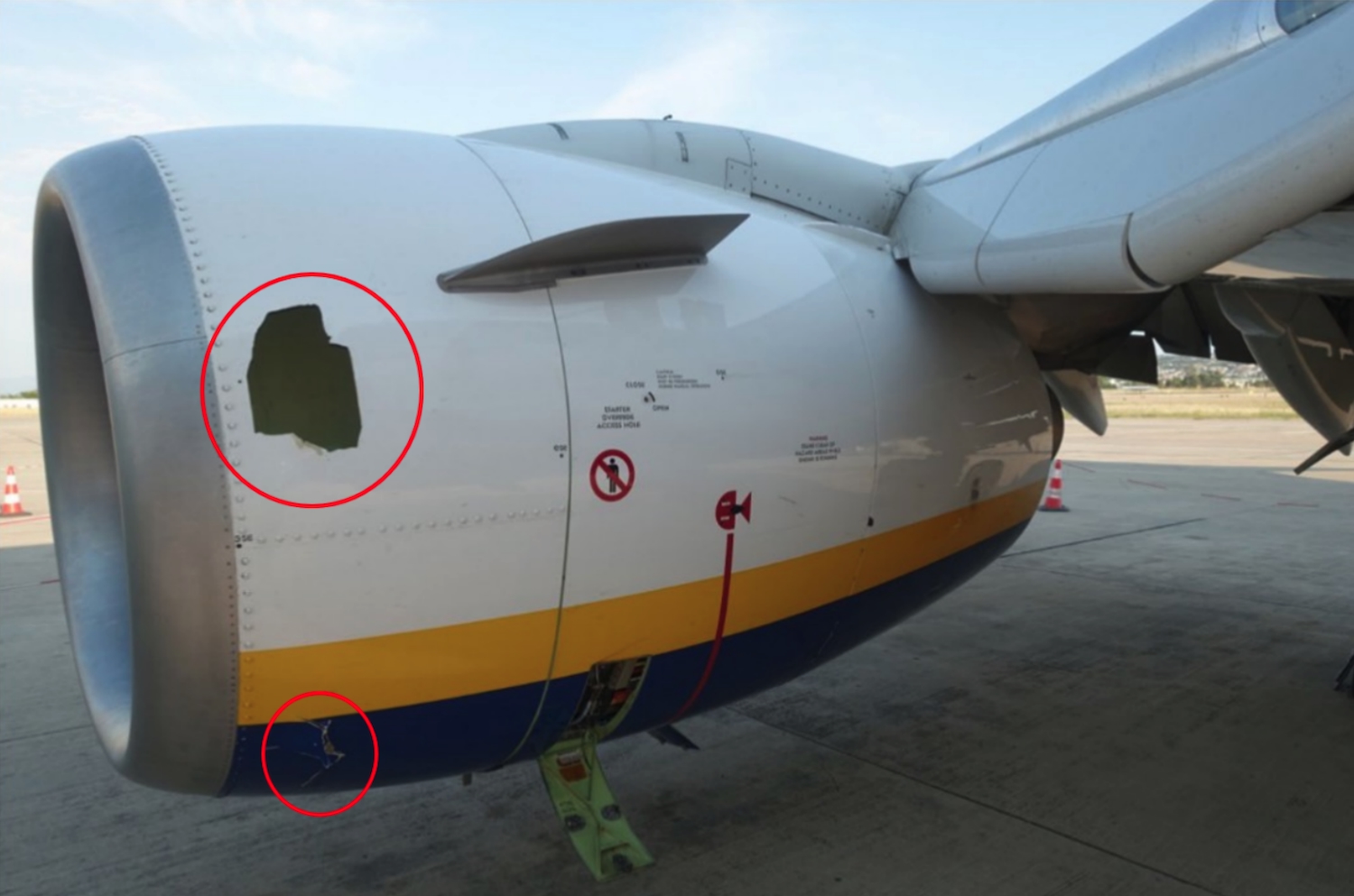
Engine fragments pierced the fuselage and the jet’s cabin depressurized, the NTSB said in a preliminary report Thursday on the July 10 accident. Only one of the 155 people on board was harmed. A passenger was partially lodged in a window that blew out, suffering serious injuries before being rescued by other travelers.
The NTSB noted in its report that “bird remains, including feathers, were recovered from the forward face of [integrated drive generator] oil cooler, one of the thrust reverser blocker door drag links, and the lower (6 o’clock position) of the engine fan case near the thrust reverser split flange.” The remains were transported to the Smithsonian Institution Feather Identification Lab in Washington, DC for examination.
Flight crews reported four suspected bird strikes to the damaged engine in the 12 months preceding the accident. Investigators are also closely examining damage to a shim structure as part of the blade attachment after also finding fractures in the surface of the failed blade “consistent with fatigue.” The NTSB said the blades were most recently inspected on May 24.
On July 20, Ryanair CEO Michael O’Leary said a foreign object struck the aircraft triggering the series of events that led to the depressurization. That drew a sharp rebuke from NTSB Chair Jeniffer Homendy who said the comments risked violating the ICAO’s protocol for sharing information on aircraft investigations.
The plane’s number two CFM56-7B26 engine was heavily damaged. It experienced a fan blade separation, with engine fragments striking the fuselage and right horizontal stabilizer. One fan blade fractured and separated below the blade platform, while the outer blade tips were fractured and separated on two additional blades. All remaining blades exhibited “impact deformation,” the NTSB report said.
The NTSB also detailed extensive damage to kevlar coverage that is designed to contain engine debris from a fan blade failure. The engine had not been outfitted with reinforcements for the fan and inlet cowl hardware and exhaust nozzle that were recommended by the FAA in several 2025 Airworthiness Directives, the report noted.
Boeing 737 Next Generation operators have until July 2028 to comply with the ADs, which were issued in response to two earlier blade-out failures aboard Southwest Airlines 737s in 2016 and 2018.
Subscribe to The Air Current
Our award-winning aerospace reporting combines the highest standards of journalism with the level of technical detail and rigor expected by a sophisticated industry audience.
- Exclusive reporting and analysis on the strategy and technology of flying
- Full access to our archive of industry intelligence
- We respect your time; everything we publish earns your attention