
Log-in here if you’re already a subscriber
Air safety reporting by The Air Current is provided without a subscription as a public service. Please subscribe to gain full access to all our scoops, in-depth reporting and analysis.
In rare public comments on last year’s fatal midair collision between a U.S. Army Black Hawk helicopter and an American Airlines regional jet, the commanding general of Army Aviation, Maj. Gen. Clair Gill, implied that faulty altimeters and outdated avionics in the accident helicopter did not substantially contribute to the crash.
During a media briefing on Bell’s MV-75 tiltrotor, which is slated to eventually replace most of the Black Hawk fleet, The Air Current asked Gill whether the D.C. crash changed the branch’s thinking about fielding the Black Hawk’s partial replacement. “No, it’s completely unrelated,” he replied. The MV-75 will have “a more advanced cockpit, but the D.C. crash really wasn’t about whether or not it was an advanced cockpit or not.”
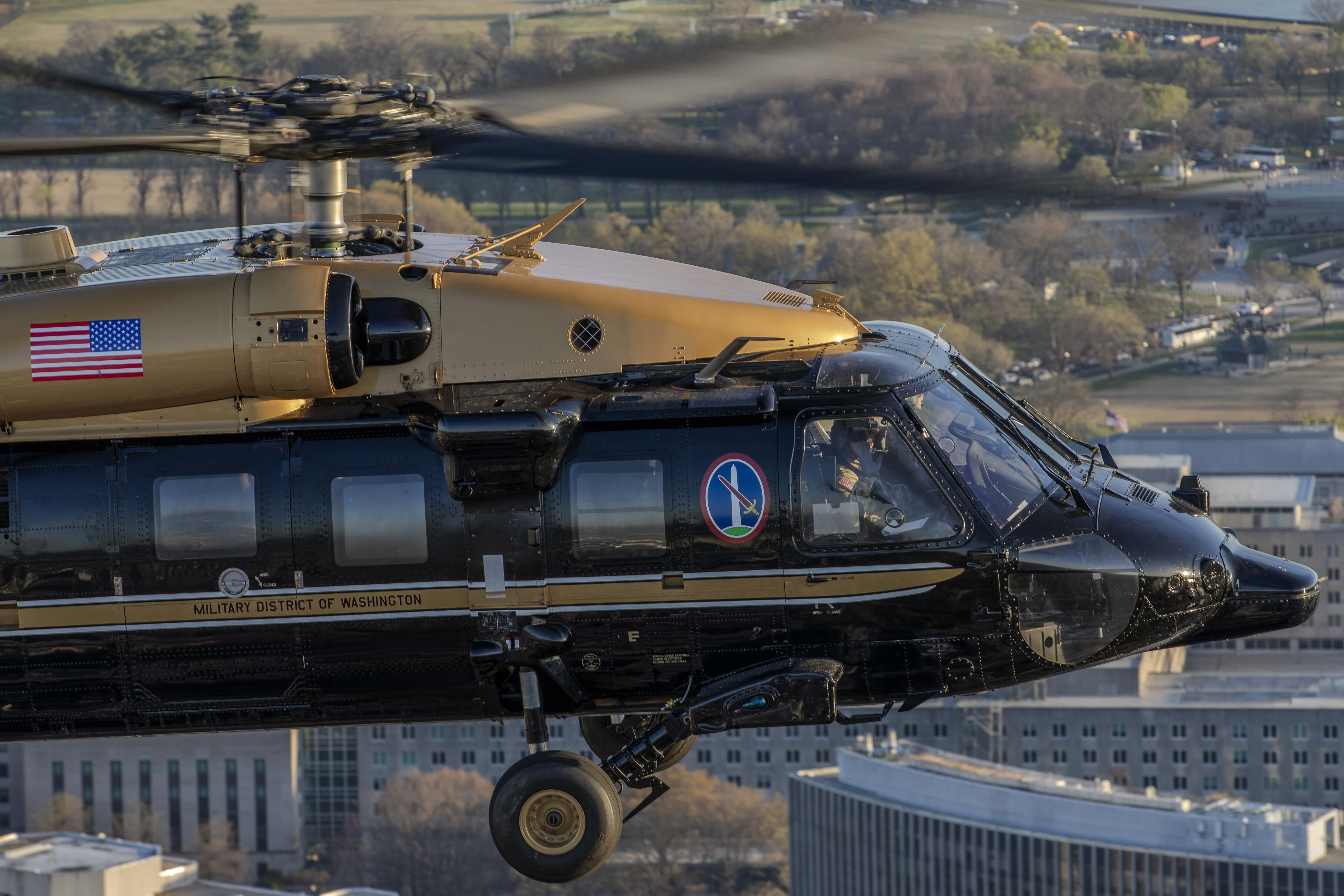
Although the U.S. National Transportation Safety Board identified systemic failures in airspace design and management as the probable cause of the midair collision, it also found that the Army should have identified and addressed hazards associated with altitude exceedances on the Washington, D.C. helicopter routes — a problem that was likely exacerbated by inaccurate altimeters on older UH-60L “Lima” Black Hawks including the one involved in the crash.
As previously detailed by TAC, helicopters on the D.C. route where the 2025 accident occurred exceeded maximum charted altitude limits nearly 20% of the time, causing conflicts with commercial aircraft operating at Washington, D.C.’s Reagan National Airport (DCA). About 80% of the traffic on routes near DCA were military helicopters. In January, the NTSB determined that altimeters onboard the accident Black Hawk were faulty and found similar issues with other older “Lima” models during post-accident testing.
Related: Special Report: The night everything at DCA finally went wrong
Black Hawk manufacturer Sikorsky shared the inherent limitations of the aircraft’s altimeter with the Army when the aircraft was developed in the 1970s, but those risks were not communicated to pilots.
The Board also scrutinized the Army’s lack of installed collision avoidance and situational awareness technology on its Black Hawk helicopters, which it said could have helped avoid the accident. These types of systems can augment a crew’s ability to spot other aircraft, especially in busier airspace like where the D.C. crash occurred.
Where the newer UH-60M “Mike” model helicopters have modern glass avionics and the ability to accommodate newer safety tools, the older Lima and Alpha models have the same “six-pack” cockpit originally designed in the 1970s. Army pilots told DCA crash investigators that quirks of the Lima helicopter made it a more difficult aircraft to fly, especially for new pilots.
The Army still operates hundreds of the older UH-60L (and some original UH-60A models in the Army National Guard), which have proven difficult and costly to upgrade as the fleet ages.
The force is procuring new UH-60M models and in 2019 stood up a program to upgrade the Lima and Alpha models with modern avionics. Earlier this year, the Army announced it is exploring how to conduct mid-life overhauls for those aircraft that could enable them to fly past 2050. Gill said the still-in-development MV-75 would be easier to upgrade given its modular open system approach (MOSA) software design which allows for rapid integration of different avionics systems from different suppliers.
In a statement to TAC, Army spokesman Maj. Montrell Russell said that the service has “clearly communicated with congressional leaders and the NTSB” its commitment to fielding new situational awareness technology, such as location tracking ADS-B, through the use of more portable electronic flight bags.
The Army additionally has proposed “upgrade options that include integrating ADS-B In capability through an aircraft transponder upgrade, which is scheduled to start in late FY27, contingent upon resource allocations,” Russell said. He added that the Army will continue to support research into next-generation collision avoidance tools.
“Army leaders have outlined the cost and capability requirements for both approaches to quickly meet NTSB and legislative mandates aimed at enhancing aviation safety for our crews and the public.”
The Army has yet to ink a new multi-year Black Hawk procurement deal that would allow accelerated retirement of its older models. Deliveries under the most recent contract signed with Sikorsky in 2022 are currently slated to continue through 2027.
“Whether we would enter into a multi-year [contract], part of that is going to be a Congressional decision, whether they give us that authority or not,” Brent Ingraham, acting assistant secretary of defense for acquisition, said during the same media briefing. “But we are currently looking at how we would ensure, through a multiple-year contract, that we are driving the appropriate demand signals to industry.”
Subscribe to The Air Current
Our award-winning aerospace reporting combines the highest standards of journalism with the level of technical detail and rigor expected by a sophisticated industry audience.
- Exclusive reporting and analysis on the strategy and technology of flying
- Full access to our archive of industry intelligence
- We respect your time; everything we publish earns your attention